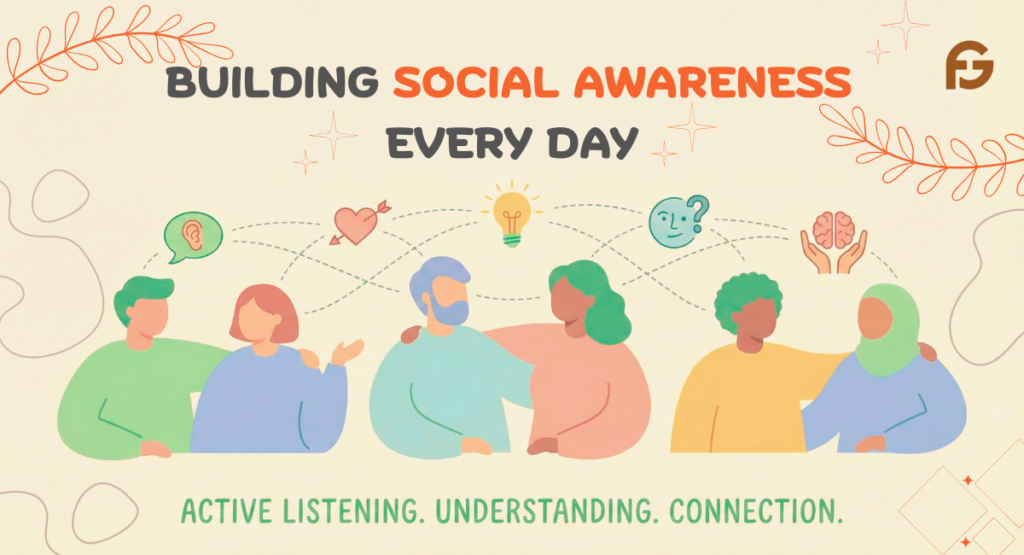
Ever walked into a room and immediately sensed tension hanging in the air? That uncomfortable feeling isn’t a coincidence; it’s your social awareness picking up signals others completely miss. You’re reading body language cues, detecting tone shifts, and interpreting unspoken cues without even realizing it. Here’s the powerful truth: understanding others’ emotions isn’t some mystical gift reserved for naturally charismatic people.
It’s a learnable skill that transforms everything: your career trajectory, personal relationships, mental well-being, and daily interactions. Most people stumble through conversations, missing critical emotional information. They wonder why connections feel shallow, or conflicts seem to explode from nowhere.
This comprehensive guide reveals exactly how to sharpen your perceptiveness and build genuine emotional intelligence. Ready to stop guessing what people really mean? Let’s unlock your social awareness potential.
What Is Social Awareness?
What is social awareness, really? It’s your ability to accurately perceive and understand the emotions, needs, and concerns of others. You’re recognizing emotional cues beyond what people explicitly say. Someone’s smiling, but their shoulders are hunched. Their voice sounds cheerful, yet something feels off. You sense discomfort even though they haven’t verbalized it.
Think of it as your emotional radar system for navigating social situations. While self-awareness and growth focus inward on your feelings, social awareness turns that lens outward. This skill forms one of four pillars of emotional intelligence, alongside self-awareness, emotional regulation, and relationship management.
Key Distinctions:
- Self-awareness = knowing your own emotional landscape
- Social awareness = reading everyone else’s emotional state
- One looks in the mirror, the other scans the room
- Both are essential for sophisticated interpersonal skills
Emotional intelligence isn’t complete without strong social awareness skills. People with high EQ excel at picking up verbal and nonverbal cues. They notice microexpressions, tone shifts, and body language cues that telegraph someone’s true emotional state. This creates meaningful interactions because you’re responding to reality, not just surface conversation.
Why Social Awareness Matters in Today’s World
Why social awareness is important has never been clearer. We have tons of digital connections but lack real human contact. Text messages can’t show tone. Zoom calls miss emotional details. Meanwhile, workplace communication requires us to work together across different cultures and time zones.
Personal relationships crumble when partners can’t read each other’s emotional states. Friendships fade because nobody recognizes when someone needs support. Developing social awareness for relationships directly improves relationship quality by fostering mutual respect and deeper understanding.
Core Benefits:
- Enhanced interpersonal skills in professional settings
- Stronger personal relationships and social connections
- Better mental health support and reduced anxiety
- Improved community connection through inclusive environment creation
The emotional well-being benefits are massive. People with strong social awareness skills report lower social anxiety. They navigate conflicts smoothly by catching tension early. Building emotional intelligence creates a buffer against loneliness and isolation.

The 5 Core Components of Social Awareness
Think of social awareness as a symphony, not a solo instrument. Each component harmonizes with the others. You can’t master just one and call yourself socially aware.
- Empathy and Emotional Recognition
Empathy skills come in two flavors: cognitive and affective. Cognitive empathy means intellectually understanding someone’s feelings. Affective empathy means actually feeling those emotions with them. Both matter for recognizing emotions accurately. This dual awareness transforms superficial exchanges into supportive interactions that genuinely help people feel seen.
- Active Listening Skills
Real active listening goes beyond nodding politely while planning your next comment. You’re fully present, absorbing both content and emotion. Improving communication skills starts here because most breakdowns stem from poor listening rather than poor speaking. Try reflecting on what you heard: “It sounds like you’re frustrated because…” This demonstrates genuine engagement.
- Understanding Nonverbal Cues
Research estimates that verbal and nonverbal cues split communication: 7% words, 38% tone, 55% body language. Your ability to read body language determines whether you catch what’s really happening beneath surface conversations. Reading social cues requires matching nonverbal communication patterns with situational factors and verbal content.
- Perspective-Taking Abilities
Understanding others’ perspectives demands temporarily suspending your own worldview. You’re mentally stepping into someone else’s shoes. This cognitive flexibility separates emotionally intelligent people from those assuming everyone thinks identically. Perspective-taking reduces conflicts because you understand why someone believes what they believe.
- Cultural Sensitivity
Every culture has distinct social norms around eye contact, personal space, and emotional expression. What’s polite in one context is rude in another. Developing cultural competence means recognizing these differences without judgment. This awareness is essential for social awareness in group settings where participants bring varied backgrounds.
Types of Social Awareness Skills You Need to Master
Social awareness skills aren’t one-size-fits-all. Different contexts demand distinct competencies.
- Emotional Awareness Skills
Emotional awareness forms your foundation. You’re constantly scanning environments for emotional currents, who’s energized, who’s withdrawn, where tension lurks. This involves recognizing emotional cues in facial expressions, voice fluctuations, and energy shifts. Early detection enables responding with empathy before situations deteriorate.
- Communication and Interpersonal Skills
True interpersonal communication means adapting your style to your audience. You speak differently with your boss than with your best friend. Improving interpersonal communication requires reading real-time feedback during conversations. Are they engaged or checked out? This dynamic responsiveness creates meaningful interactions.
- Social-Emotional Learning (SEL) Competencies
Social-emotional learning frameworks emphasize five core competencies: self-awareness, self-management, social awareness, relationship skills, and responsible decision-making. Evidence-based emotional skills training produces measurable improvements in workplace satisfaction and relationship-building capacity
- Organizational Awareness
Corporate environments have invisible power structures. Organizational awareness means understanding these dynamics, who influences whom, where alliances exist, and how decisions really get made. This skill is critical for social awareness at work because it helps you navigate complex hierarchies effectively.
Real-Life Examples of Social Awareness in Action
Examples of social awareness make the concept tangible. Social awareness examples in real life span every domain where humans interact.
- In the Workplace
Your colleague usually participates actively in meetings but has been unusually quiet. Instead of ignoring it, you check in privately. Turns out they’re managing a family crisis. Your social awareness in the workplace allows supportive interactions rather than assuming they’re disengaged. Strong workplace communication skills are especially valuable in careers requiring high emotional intelligence and minimal conflict. - In Personal Relationships
Your partner says they’re fine, but their body language screams otherwise. Instead of accepting the surface response, you create space for them to share when ready. This social awareness for relationships deepens intimacy because your partner feels truly known. - During Social Gatherings
You notice someone standing alone, looking uncomfortable at a party. Rather than assuming they prefer solitude, you make gentle conversation. This social awareness in group settings creates an inclusive environment where everyone belongs. - In Educational Settings
A teacher notices a typically engaged student has become withdrawn. Instead of disciplining declining participation, they investigate whether something’s wrong. This social behavior awareness prevents problems from escalating while demonstrating care beyond academics.
7 Powerful Benefits of Developing Social Awareness
Investing in social awareness yields returns across every dimension of life. Benefits of social awareness compound over time as skills deepen and become automatic.
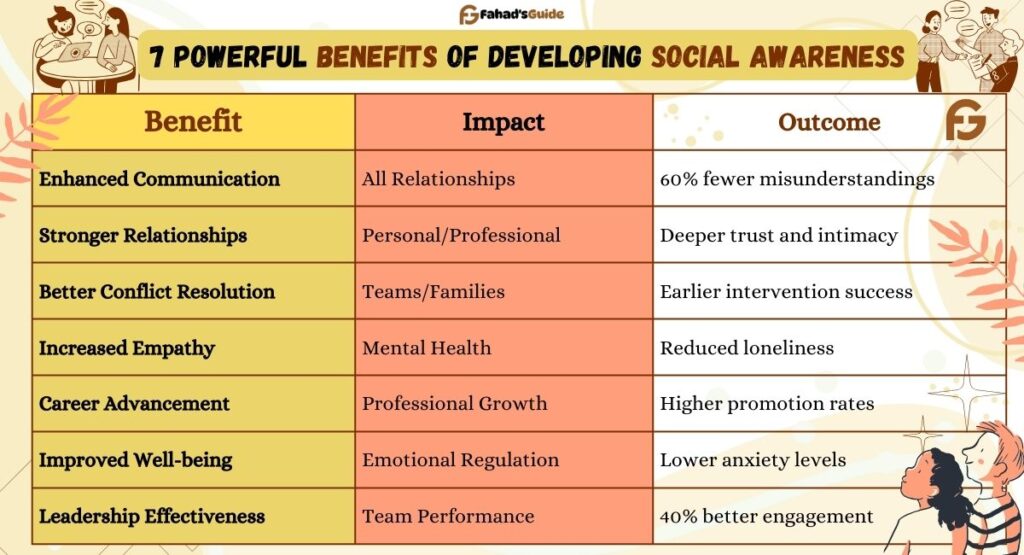
Enhanced communication tops the list because virtually every interaction improves. Misunderstandings decrease when you’re accurately reading verbal and nonverbal cues. Stronger relationships emerge when people feel genuinely understood. Better conflict resolution develops as you recognize tensions before they explode. Your compassion and empathy muscles strengthen with use.
Building social awareness contributes significantly to emotional well-being and helps combat feelings of isolation and loneliness.
How Social Awareness Differs from Self-Awareness
People constantly confuse these two components of emotional intelligence. Self-awareness means understanding your own emotions, triggers, and values. Social awareness directs attention outward toward others’ emotional states and social norms.
Key Differences:
- Self-awareness asks, “What am I feeling?”
- Social awareness asks, “What are they experiencing?”
- One is internal focus, the other is external
- Both are essential for sophisticated emotional intelligence and social skills
The magic happens when you develop both simultaneously. Building emotional intelligence requires balancing both capacities. Mindfulness practices are enhanced by training present-moment awareness. The skills reinforce each other even though they’re theoretically distinct.
Signs You Need to Improve Your Social Awareness
Sometimes we’re the last to recognize our own blind spots. How to be more socially aware starts with an honest assessment of current competencies.
Warning Signs:
- Frequently surprised by others’ emotional reactions
- People tell you you’re “intimidating” or “hard to read.”
- Conversations die quickly when you join groups
- You receive feedback about being “oblivious.”
- Conflicts seem to come from nowhere
- You struggle with naming emotions in yourself or others
- Small talk feels impossibly difficult
- You can’t tell when someone wants to end a conversation
Social cues in conversations often whoosh past people with low awareness. Sarcasm confuses them. Hints go unnoticed. This literal interpretation creates constant misunderstandings because understanding unspoken cues matters more than explicit words.
10 Practical Ways to Improve Your Social Awareness
Ready to build social awareness systematically? These strategies work if you actually implement them. How to improve social awareness isn’t mysterious; it’s the repetition of deliberate behaviors.
- Practice Active Listening Daily
Put your phone face-down during conversations. Reflect what you heard before replying: “It sounds like you’re saying…” This demonstrates genuine engagement while ensuring accurate understanding.
- Observe Body Language and Facial Expressions
Start people-watching with intention. Notice body language cues in coffee shops. How do people hold themselves when confident versus anxious? Reading body language improves through pattern exposure.
- Ask for Honest Feedback
Identify three people who’ll be candid. Ask: “Do I interrupt people? Do I seem checked out during conversations?” Stay open and non-defensive. External perspectives reveal blind spots you’ll never catch alone.
- Develop Cultural Competence
Consume media from diverse cultures. Notice how social norms around directness and eye contact vary across cultures. Challenge your assumptions about “normal” social behavior.
- Practice Mindfulness and Self-Reflection
Daily meditation builds present-moment awareness essential for recognizing emotional cues. Journal about social interactions afterward. What went well? Where did you miss signals?
- Engage in Diverse Social Situations
Attend events outside your normal circles. Each context teaches new social awareness lessons because unspoken rules vary across groups. Discomfort signals growth.
- Read Emotional Intelligence Books
Daniel Goleman’s Emotional Intelligence remains foundational. Brené Brown’s work on vulnerability provides practical insights into connection and empathy. Supplement reading with application.
- Join Group Activities or Therapy
Group therapy benefits include safe spaces for practicing social awareness with immediate feedback. Alternatively, join team sports or community groups requiring collaboration.
- Learn from Social Mistakes
Analyze failures without shame. What signals did you miss? Apologize genuinely when you cause unintended hurt. Mistakes are learning opportunities when approached with curiosity.
- Use Technology Mindfully
Commit to phone-free dinners and gatherings. When with people physically, be fully present mentally. Technology should enhance rather than replace face-to-face social connections.
How to Teach Social Awareness to Children and Students
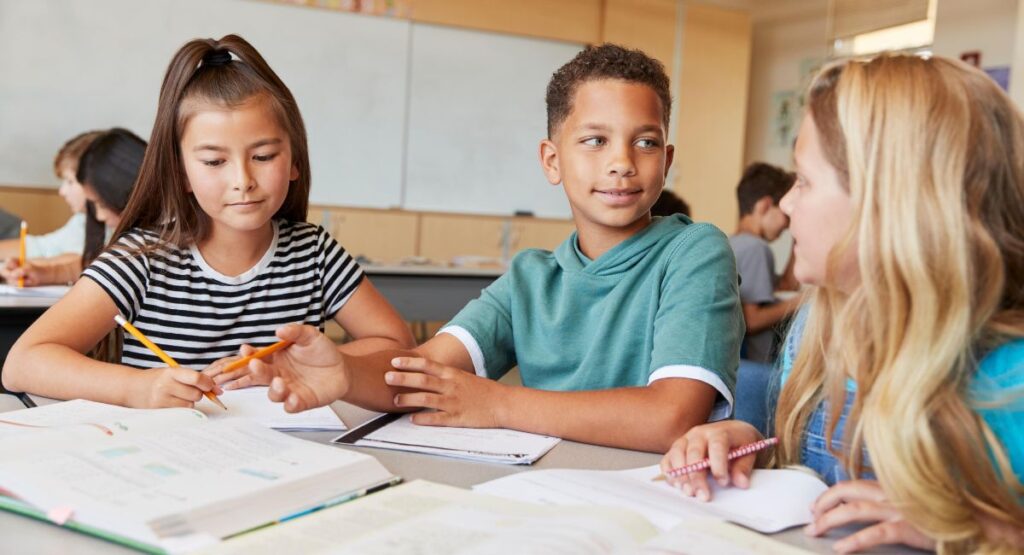
Kids aren’t born understanding emotional nuance; they develop it through modeling and practice. Social-emotional development during childhood predicts adult outcomes more reliably than IQ.
Effective Strategies:
- Age-appropriate emotion vocabulary (happy, sad, frustrated, proud)
- Classroom activities like emotion charades and role-playing
- Model empathetic behavior by labeling emotions: “You seem really frustrated.”
- Create safe spaces for emotional expression
- Story time discussions exploring characters’ motivations
Schools implementing comprehensive social-emotional learning programs report decreased bullying and improved classroom climate. Teaching starts with emotion vocabulary and progresses to complex perspective-taking exercises.
Social Awareness in Leadership and the Workplace
Social awareness at work separates mediocre managers from inspiring leaders. Technical expertise gets you hired. Emotional intelligence gets you promoted.
Leadership Impact Areas:
- Team Dynamics: Great leaders notice when someone’s disengaged and investigate why. They recognize talent being underutilized and create growth opportunities. Impact on team dynamics from socially aware leadership is profound; morale improves, turnover decreases.
- Improving Collaboration: Socially aware leaders accommodate different communication preferences. Some team members need processing time while others think aloud. They leverage diversity as a strength.
- Creating Inclusive Work Environments: Leaders with strong social awareness notice patterns, are women consistently interrupted? They intervene to ensure equity. Inclusive environment creation requires active social behavior awareness.
- Conflict Management: Leaders sense tension before it explodes and facilitate early conversations. Understanding all perspectives helps them mediate fairly. Their emotional regulation techniques keep disputes from escalating.
Common Mistakes That Damage Social Awareness
Even well-intentioned people sabotage their social awareness through unconscious habits.
Top Pitfalls:
- Making assumptions about others’ feelings instead of asking
- Ignoring cultural differences and assuming your norms are universal
- Poor listening habits, such as interrupting or multitasking
- Lack of emotional regulation is clouding your perceptiveness
- Projection errors, attributing your feelings to others
- Giving unsolicited advice instead of just listening
- Dismissing emotions as “overreacting.”
Combat these by defaulting to genuine questions: “I’m noticing you seem withdrawn. What’s going on for you?” Cultivate curiosity about different customs without judgment.
Measuring and Assessing Your Social Awareness Level
You can’t improve what you don’t measure. How to build social awareness requires a baseline assessment.
| Assessment Method | Best For | Key Benefit |
| Self-Questionnaires | Initial awareness | Immediate, free, private |
| Professional Tests (EQ-i, MSCEIT) | Serious development | Validated, benchmarked |
| 360-Degree Feedback | Workplace contexts | Multiple perspectives |
| Journaling | Daily practice | Patterns over time |
| Therapy/Coaching | Deep transformation | Expert guidance |
Professional assessments like the EQ-i 2.0 provide standardized measurement frameworks validated through research. Combine self-assessment with external feedback for accurate pictures of strengths and development areas.
Taking Action: Your Social Awareness Development Plan
Knowledge without application changes nothing. Building social awareness demands intentional practice integrated into daily routines.
Your Action Plan:
- Create Personal Goals: Use SMART criteria. Instead of “get better at social awareness,” try “practice active listening in three conversations daily for thirty days without interrupting.”
- Daily Practices: Start each morning by setting an intention. End each evening reflecting on successes and struggles. Five-minute check-ins create consistency.
- Resources for Learning: Books, podcasts, online courses, and mental health support professionals. Choose resources matching your learning style.
Next Steps: Choose three strategies from this guide. Schedule them into your calendar for the next week. Identify one person who’ll provide honest feedback. Commit to one month of focused practice.
Final Thoughts: Social awareness isn’t a destination; it’s a lifelong journey of deepening understanding and connection. Every interaction offers new learning opportunities if you stay curious. The effort invested in building emotional intelligence yields returns across every dimension of existence. Your personal relationships deepen. Your workplace communication improves. You contribute to building inclusive communities where everyone feels valued. Start today. Choose one strategy and implement it immediately. Meaningful interactions await.