
Learning how to make a budget is the single most important financial skill you’ll ever master, yet most people never actually create one. If you’re tired of wondering where your money disappears each month, constantly stressing about bills, or feeling like you’re working hard but getting nowhere financially, a proper budgeting plan changes everything.
The truth is that budgeting isn’t about restriction or living miserably. It’s about taking control of your personal finances, making intentional decisions with your money, and finally achieving your financial goals. Whether you want to pay off debt, save for a house, or simply stop living paycheck to paycheck, this complete guide will show you exactly how to create a monthly budget that actually works for your unique situation and lifestyle.
Why You Absolutely Need a Budget (Even If You Hate the Idea)
Let me be completely honest with you. The word “budget” sounds boring. It sounds restrictive. It sounds like someone telling you that you can’t have fun anymore. I get it. That’s probably why you’ve avoided making one for so long.
But here’s the truth that changed my perspective completely: budgeting isn’t about limiting your life. It’s about designing it.
Think about it this way. Would you start a road trip without knowing where you’re going or how much gas you have? Would you build a house without blueprints? Of course not. Yet that’s exactly what you’re doing when you live without a budget, just hoping things work out somehow.
According to Consumer Financial Protection Bureau research, people who create and follow budgets report significantly less financial stress, better emergency preparedness, and faster progress toward major life goals. The data doesn’t lie. Budgeting works.
Here’s what a good budget actually does for you:
- Eliminates money anxiety. No more lying awake at 2 AM wondering if you can afford rent next month or whether that random charge will overdraft your account.
- Reveals spending leaks. Most people have no idea they’re spending $300 monthly on subscriptions they barely use or $500 on dining out when they thought it was “maybe $200.”
- Creates financial progress. Want to buy a house? Pay off student loans? Take that dream vacation? None of it happens without a plan. A budget is that plan.
- Prevents debt accumulation. When you know exactly how much you can spend, you stop accidentally living beyond your means and racking up credit card debt.
- Builds genuine wealth. The difference between people who build wealth and those who don’t isn’t usually income. It’s intentionality. Budgets create that intentionality.
Step 1: Calculate Your Monthly Income (Know What You’re Working With)
Before you can decide how to spend your money, you need to know exactly how much you have. This sounds obvious, but most people get this step wrong, and it sabotages their entire budget.
For salaried employees: Don’t look at your gross salary. That’s not what you actually get. Look at your net income or take-home pay, the amount that hits your bank account after taxes, insurance, 401(k) contributions, and other deductions.
Example: If your annual salary is $60,000, your gross monthly income is $5,000. But after taxes and deductions, you might only take home $3,800. That $3,800 is what you budget with, not the $5,000.
For hourly workers: Multiply your hourly rate by the number of hours you work per week, then multiply by 4.33 (the average number of weeks per month). Again, remember to account for taxes.
For variable income (freelancers, commission-based, gig workers): This is trickier. According to Bank of America’s budgeting guide, look at your last six to twelve months of income, add it all up, and divide by the number of months to find your average monthly income. Budget conservatively using this average.
Don’t forget additional income sources:
- Side hustles or freelance work
- Rental property income
- Child support or alimony
- Social Security or disability benefits
- Investment dividends or interest
Pro tip: If your income varies, budget using your lowest month from the past year. This way, you’re always prepared for lean months and any extra becomes bonus savings.
Step 2: Track All Your Expenses (The Eye-Opening Reality Check)

This is where most people get shocked. And honestly, that shock is healthy. You need to see where your money actually goes, not where you think it goes.
Fixed expenses are easy. These stay the same every month:
- Rent or mortgage payment
- Car payment
- Insurance (health, auto, renters/homeowners)
- Loan payments (student loans, personal loans)
- Subscriptions you never cancel (Netflix, Spotify, gym)
- Phone bill
- Internet
Variable expenses change month to month:
- Groceries
- Gas and transportation
- Utilities (electric, water, gas)
- Dining out and takeout
- Entertainment
- Clothing
- Personal care (haircuts, toiletries)
- Medical expenses
- Home maintenance
- Pet expenses
The tracking challenge: For one full month, write down literally every single expense. Use your bank statements, credit card statements, receipts, everything. According to Morgan Stanley’s financial planning research, this tracking month reveals spending patterns most people never realized existed.
Don’t forget the irregular expenses that sneak up on you:
- Annual insurance premiums
- Car registration
- Holiday gifts
- Birthday presents
- Vacation costs
- Annual subscriptions
The trick with irregular expenses is to divide the annual cost by 12 and budget that amount monthly. If you spend $1,200 on holiday gifts every year, budget $100 monthly so you’re never caught off guard
Step 3: Choose Your Budgeting Method (Find What Fits Your Life)
Here’s where budgeting gets personal. There’s no one-size-fits-all approach. The best budget is the one you’ll actually stick with. Let me break down the most popular and effective methods.
The 50/30/20 Rule (Best for Beginners)
This is the simplest, most straightforward budgeting method, popularized by Senator Elizabeth Warren. According to Chase Bank’s financial education resources, here’s how it works:
50% for NEEDS: Essential expenses you can’t avoid
- Housing (rent/mortgage)
- Groceries
- Utilities
- Transportation
- Insurance
- Minimum debt payments
30% for WANTS: Things that improve your life but aren’t essential
- Dining out
- Entertainment
- Hobbies
- Subscriptions
- Shopping
- Travel
20% for SAVINGS & DEBT: Building your future
- Emergency fund
- Retirement contributions
- Extra debt payments
- Investment accounts
- Specific savings goals
Example: If your monthly income is $4,000 after taxes:
- $2,000 for needs
- $1,200 for wants
- $800 for savings and debt repayment
The beauty of the 50/30/20 budget is flexibility. If your rent is high and needs to take 60%, adjust to 25% and savings to 15%. The framework is your guide, not your prison.
Zero-Based Budgeting (Best for Detail-Oriented People)
With zero-based budgeting, every single dollar gets assigned a specific job. Your income minus your expenses should equal zero by the end of the month.
This doesn’t mean you’re broke. It means you’ve accounted for everything, including savings and investments. Nothing is left to chance.
How it works:
- List your monthly income: $4,000
- Assign every dollar a purpose:
- Rent: $1,200
- Groceries: $500
- Car payment: $350
- Insurance: $200
- Utilities: $150
- Gas: $200
- Dining out: $300
- Entertainment: $200
- Emergency fund: $400
- Retirement: $400
- Personal spending: $100
Total: $4,000 (equals income)
According to U.S. Bank’s budgeting resources, zero-based budgeting builds incredible financial awareness because you can’t accidentally overspend. Every purchase requires pulling from a specific category.
The Envelope System (Best for Overspenders)
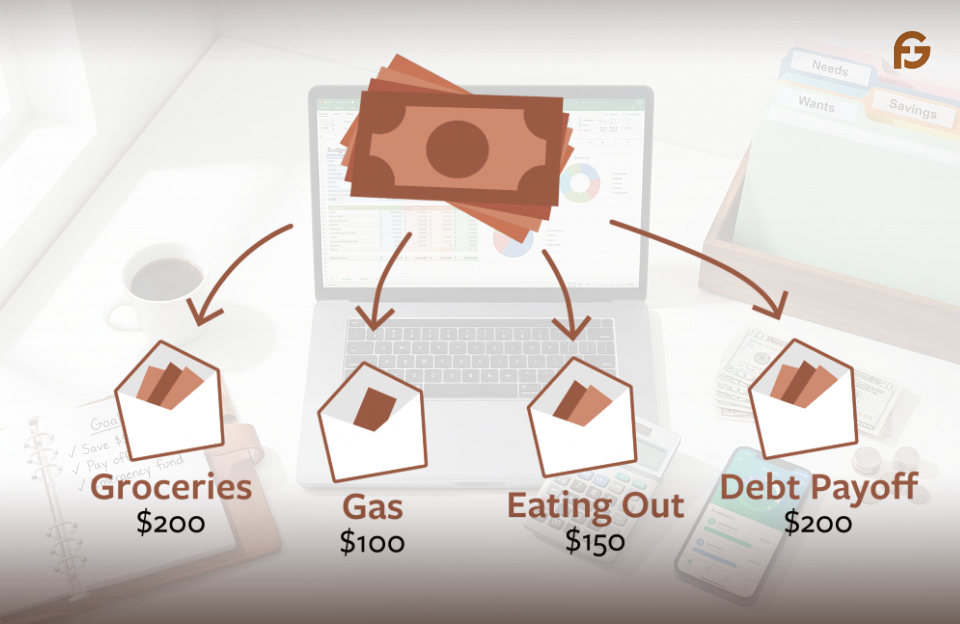
This old-school method still works beautifully. You divide cash into physical envelopes labeled with spending categories. When an envelope is empty, you’re done spending in that category until next month.
Modern twist: You don’t need physical envelopes anymore. Many banking apps let you create virtual “envelopes” or sub-accounts for different spending categories.
Pay Yourself First (Best for Savers)
This method flips traditional budgeting. Instead of saving whatever’s left at the end of the month (spoiler: there’s never anything left), you pay your savings first.
How it works:
- Decide how much to save monthly (maybe 15-20% of income)
- Set up an automatic transfer to a savings account on payday
- Live on what remains
This is particularly effective because most people spend whatever money they see in their checking account. By moving savings first, you never see it, so you don’t miss it.
Step 4: Set Clear Financial Goals (Know Why You’re Doing This)
Budgets without goals are just spreadsheets. Goals give your budget meaning, purpose, and motivation when temptation strikes.
Short-term goals (1-3 years):
- Build a $1,000 emergency fund
- Pay off credit card debt
- Save for vacation
- Buy a used car with cash
- Build a 3-6 months emergency fund
Medium-term goals (3-10 years):
- Save house down payment
- Pay off student loans
- Save for the wedding
- Start an investment portfolio
- Build $50,000 net worth
Long-term goals (10+ years):
- Retire comfortably
- Pay off the mortgage
- Fund children’s college
- Achieve financial independence
- Build generational wealth
Write your goals down. Be specific. “Save money” is vague and useless. “Save $15,000 for house down payment by December 2027” is concrete and motivating.
Step 5: Actually Create Your Budget (Putting It All Together)
Now you’re ready to build your actual budget. Here’s the step-by-step process:
1. List your total monthly income: $4,000 (using our example)
2. List all fixed expenses:
- Rent: $1,200
- Car payment: $300
- Car insurance: $150
- Phone: $80
- Internet: $70
- Subscriptions: $50 Total fixed: $1,850
3. List variable expenses (use your tracking data):
- Groceries: $500
- Gas: $200
- Utilities: $150
- Dining out: $250
- Entertainment: $150
- Personal care: $100 Total variable: $1,350
4. List savings and debt goals:
- Emergency fund: $300
- Retirement: $400
- Extra credit card payment: $100 Total savings: $800
5. Do the math: Income: $4,000 Fixed expenses: $1,850 Variable expenses: $1,350 Savings/debt: $800 Total expenses: $4,000
Leftover: $0 (perfect in zero-based budgeting)
If your expenses exceed income, something has to change. According to the Consumer Financial Protection Bureau, focus on reducing variable expenses first, they’re easiest to adjust.
Look for cuts:
- Reduce dining out from $250 to $150 (save $100)
- Lower entertainment from $150 to $100 (save $50)
- Find a cheaper phone plan, $80 to $60 (save $20)
That $170 monthly savings becomes $2,040 annually. That’s a vacation, emergency fund boost, or serious debt paydown.
Step 6: Use Tools to Make Budgeting Easier (Work Smarter, Not Harder)

You don’t need to manually track everything with pen and paper unless you want to. Modern technology makes budgeting significantly easier.
Spreadsheet templates: Free Google Sheets or Excel templates let you customize categories and see everything visually. Many templates automatically calculate totals and remaining balances.
Budgeting apps: Tools like YNAB (You Need A Budget), Mint, EveryDollar, and PocketGuard sync with your bank accounts and categorize transactions automatically. Most banks also offer built-in budgeting tools in their mobile apps.
Automatic alerts: Set up notifications when you’re approaching category limits or when unusual charges appear. Prevention is easier than damage control.
Step 7: Review and Adjust Monthly (Budgets Aren’t Set-and-Forget)
Your budget is a living document. Life changes, expenses shift, income fluctuates. Review your budget at least monthly, preferably weekly when you’re starting out.
Weekly quick check: Spend 15 minutes reviewing transactions, ensuring you’re on track, and adjusting if needed.
Monthly deep dive: Analyze the full month. Did you stay within categories? Where did you overspend? What surprised you? What can improve next month?
Be honest but not harsh. Overspending on groceries because food prices increased isn’t failure. It’s information. Adjust next month’s grocery budget accordingly.
Common Budgeting Mistakes (And How to Avoid Them)
Mistake #1: Being unrealistic. Budgeting $50 monthly for groceries when you actually spend $500 sets you up for failure. Use real numbers from your tracking month.
Mistake #2: Forgetting irregular expenses. Car registration, annual insurance, holiday gifts will destroy your budget if you don’t plan for them.
Mistake #3: No emergency buffer. Build a small buffer in your budget for unexpected expenses. Life happens.
Mistake #4: Making it too complicated. If your budget requires a PhD to understand, you won’t stick with it. Simplicity wins.
Mistake #5: Beating yourself up. You will mess up. You will overspend. You will forget something. That’s normal. Adjust and continue.
According to Citizens Bank’s financial research, 84% of Americans with budgets still occasionally overspend. The key isn’t perfection, it’s consistency and adjustment.
The Bottom Line: Your Budget Is Your Financial GPS
Learning how to make a budget isn’t just about tracking numbers. It’s about taking control of your financial future. It’s about making intentional decisions instead of wondering where your money went. It’s about building the life you actually want instead of just hoping things work out.
Yes, creating your first budget takes time. The tracking month feels tedious. The calculations aren’t exciting. But neither is the anxiety of not knowing if you can pay rent, the stress of mounting debt, or the regret of never achieving your financial goals.
The best day to start your budget was a year ago. The second-best day is today. Right now. Not next month when things “settle down” or after the holidays or when you get that raise. Those are just excuses keeping you stuck.
Start simple. Choose the 50/30/20 method if you’re overwhelmed. Track your spending for one month. Use a free app or simple spreadsheet. Adjust as you learn. Give yourself grace when you mess up. Celebrate small wins like staying under budget in one category or saving your first $100.
Your budget isn’t a financial diet. It’s a financial plan. And with a plan, you can build the future you deserve, one intentional dollar at a time.
FAQs
Q: How do I make a budget if my income varies every month?
Use your lowest earning month from the past year as your baseline budget. When you earn more, the extra goes straight to savings or debt paydown. This conservative approach ensures you can always cover expenses even in lean months.
Q: What’s the fastest way to make a budget for beginners?
Start with the 50/30/20 rule. Calculate your monthly income, divide it into 50% needs, 30% wants, and 20% savings. Track your spending for one month to see if you’re within these categories, then adjust as needed.
Q: How much should I save each month?
Financial experts generally recommend saving 20% of your net income minimum. This includes emergency fund contributions, retirement savings, and specific goal savings. If 20% feels impossible, start with 10% or even 5% and gradually increase as you cut unnecessary expenses.
Q: What if I have debt? Should I save or pay off debt first? Do both. Build a small emergency fund of $1,000 first so unexpected expenses don’t create more debt. Then focus on paying off high-interest debt (credit cards) while maintaining minimum payments on everything else and contributing at least 5% to retirement if your employer matches.
Q: How often should I review my budget?
When starting out, review weekly to build the habit. Once you’re comfortable, monthly reviews work well. Always review when major life changes occur like job changes, moving, marriage, or having children.
Q: Can I budget if I live paycheck to paycheck?
Absolutely. That’s exactly when you need a budget most. Start by tracking where every dollar goes for one month. You’ll likely find spending leaks you can plug. Even saving $50 monthly creates a small emergency buffer that breaks the paycheck-to-paycheck cycle over time.
Q: What’s the difference between needs and wants in a budget?
Needs are essential for survival and basic functioning like housing, food, transportation to work, basic utilities, and minimum debt payments. Wants are things that enhance your life but aren’t essential like dining out, entertainment, subscriptions, hobbies, and vacations. When tight on money, wants get cut first.
Q: Should I include savings goals in my budget?
Yes! Treat savings like a non-negotiable bill. According to Bank of America’s financial planning guides, people who budget for savings actually save, while those who plan to “save whatever’s left” never do because there’s never anything left.