

Learning how to stop procrastinating is something I spent years getting wrong before I finally understood what procrastination actually is. I tried productivity systems, habit trackers, morning routines, and accountability partners. Some of them helped a little. None of them stuck until I stopped treating it as a time management problem and started treating it as an emotional regulation problem, which is exactly what the research says it is.
This guide covers what procrastination actually does to your day, why every popular piece of advice fails for chronic procrastinators, and the specific methods that changed things for me, including the two-minute rule, implementation intentions, and temptation bundling. These are not motivational tips. They are evidence-based strategies grounded in behavioral psychology that produce real, lasting results when applied consistently.
What Procrastination Actually Is (Most People Get This Wrong)
The most important thing to understand about procrastination is that it has almost nothing to do with laziness or poor time management. That framing is why most solutions fail. When you approach procrastination as a scheduling problem, you build better calendars and to-do lists, and then still do not do the things on them. Nothing changes because you have not addressed the actual mechanism.
Research by Dr. Timothy Pychyl at Carleton University, one of the most cited procrastination researchers in the world, shows that procrastination is fundamentally an emotion regulation problem. When we face a task that triggers negative emotions such as anxiety, boredom, frustration, self-doubt, or fear of failure, our brain seeks immediate relief. Procrastination provides that relief by allowing us to avoid the unpleasant task, at least temporarily. The avoidance feels good in the short term. The cost arrives later, and it compounds.
This matters because it completely changes how you approach fixing it. You do not fix an emotion regulation problem with a better calendar. You fix it by changing how you relate to the negative emotions that certain tasks trigger, reducing the friction between you and starting, and building small systems that make avoidance harder than action.
The statistics behind procrastination tell a striking story about how widespread this problem is. Around 20 to 25% of individuals engage in chronic procrastination, 88% of employees procrastinate for over 60 minutes daily during work hours, and procrastination costs the US economy approximately $70 billion annually. On average, a person wastes around 218 minutes every day procrastinating, which amounts to roughly 55 days per year. That is nearly two months of every year lost to avoidance.
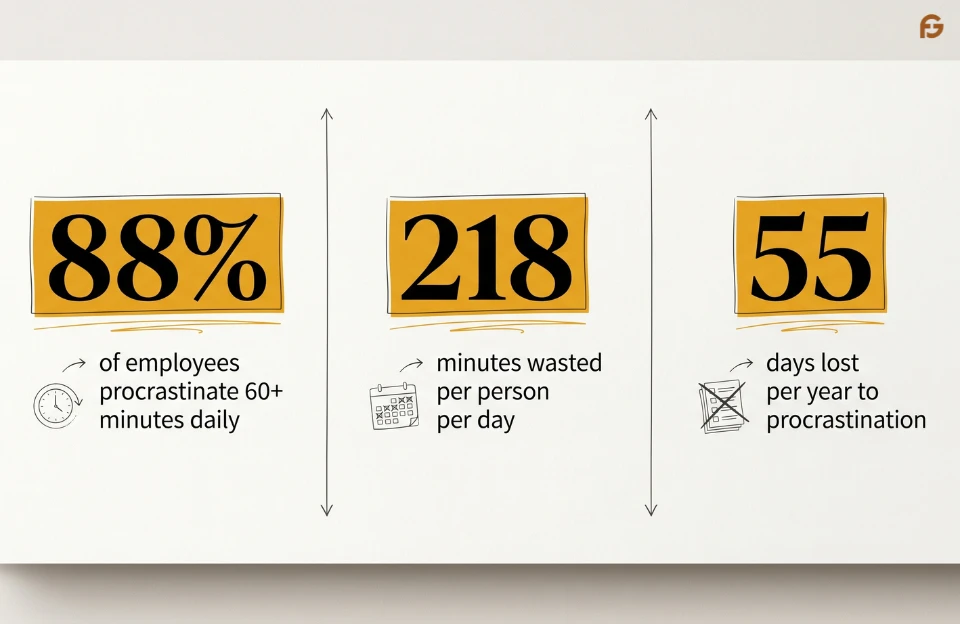
Procrastination costs the US economy approximately $70 billion annually, and on a personal level, it delays everything from career moves to finally sorting out how to make a budget.
The uncomfortable part: 94% of people who procrastinate say it makes them unhappy. They know it is costing them. They continue doing it anyway. That gap between knowing and doing is the emotional regulation problem in action.
Why You Have Tried to Fix It Before, and It Did Not Stick
Before getting into what works, it is worth being honest about what does not, and why. Most procrastination advice falls into one of three categories that sound reasonable but consistently underperform.
Category 1: Motivational advice “Just start.” “Done is better than perfect.” “You will feel better once you begin.” All of these are technically true and almost completely useless when you are in the grip of avoidance. You already know you will feel better when you start. The problem is the moment before starting, where the emotional pull toward something easier is stronger than your abstract knowledge that you should work. Motivation arrives after action, not before it. Waiting to feel motivated is the procrastination trap itself.
Category 2: Willpower-based systems. Relying on discipline and self-control to override avoidance works occasionally, but willpower is a finite resource. It depletes throughout the day, it fluctuates with sleep, stress, and hunger, and it fails precisely when you most need it. A system that requires willpower to activate will fail under pressure.
Category 3: Complexity-based productivity systems. Elaborate task management setups, color-coded planners, and detailed time-blocking schedules. These can help, but they often become a form of productive procrastination, spending time organizing work instead of doing it. If you have ever spent an hour reorganizing your to-do app and then closed it without completing anything, you know exactly what I mean.
What actually works is simpler, less intuitive, and grounded in how the brain actually processes tasks.
Method 1: The Two-Minute Rule
This is the single most effective entry-level procrastination fix I have found, and I was skeptical of it for a long time because it sounds too simple.
The rule is this: if a task takes less than two minutes to complete, do it immediately rather than adding it to a list. No scheduling, no deferring, no “I will get to that later.” Do it now, and it is done.
The broader application of this rule is even more useful. When you find yourself avoiding a large task, ask: What is the two-minute version of starting this? Not completing it. Just starting it.

Instead of “write the report,” the two-minute version is “open a new document and write one sentence.” Instead of “clean the kitchen,” the two-minute version is “put away the three things on the counter.” Instead of “start that project,” the two-minute version is “find the file and open it.”
This removes the psychological barrier to starting. Implementation intentions are if-then plans that link a situation to a behavior, and studies show they increase follow-through rates by two to three times.
The science behind why this works is straightforward. The emotional discomfort that triggers avoidance is almost entirely tied to the task as a whole, not to the first thirty seconds of engagement. Once you start, the brain re-categorizes the task from “threatening thing I am avoiding” to “thing I am currently doing.” The emotional charge drops significantly. Most of the time, the two-minute start turns into twenty minutes of work without you consciously deciding to continue.
I tested this specifically on the tasks I avoided most consistently. Emails I was anxious about, writing projects that felt overwhelming, and administrative work I resented. The two-minute start worked on all of them, not every single time, but with enough consistency to fundamentally change my daily output.
Method 2: Implementation Intentions
This is arguably the most evidence-backed method for increasing follow-through on intentions, and most people have never heard of it despite the research being robust and consistent.
An implementation intention is a specific if-then plan that links a situation to a behavior. Instead of “I will work on the project this week,” the implementation intention is “If it is 9 am on Monday, then I will open my laptop and work on the project for 25 minutes.”
The specificity is not cosmetic. It is the mechanism. Vague intentions rely on you deciding in the moment. Implementation intentions remove the decision entirely. When the trigger condition occurs (9 am Monday, finished breakfast, sitting at the desk), the behavior fires automatically without requiring a fresh act of willpower.
Studies show implementation intentions increase follow-through rates by two to three times compared to simple goal intentions. That is not a marginal improvement. It is a structural one.
The format to use is consistent: “If [specific situation], then I will [specific behavior].”
Some examples that work well in practice:
“If I make my morning coffee, then I will open my most important task before sitting down.” “If it is Sunday evening, then I will write down the three most important things I need to do tomorrow.” “If I feel the urge to check my phone instead of working, then I will place it face down and set a five-minute timer before checking.”
Notice that the last example covers the avoidance behavior itself. Implementation intentions can be used to create detours around procrastination triggers rather than just routes toward productive behavior. Both applications are useful.
Method 3: Temptation Bundling
If you can find a way to make the benefits of long-term choices more immediate, then it becomes easier to avoid procrastination. One of the best ways to bring future rewards into the present moment is with a strategy known as temptation bundling.
Temptation bundling was developed by behavioral scientist Katy Milkman at the University of Pennsylvania. The concept is straightforward: pair a task you avoid with something you genuinely enjoy, but only allow yourself the enjoyment while doing the task.
The classic example from Milkman’s research involved audiobooks. Participants who were only allowed to listen to engaging audiobooks while at the gym attended significantly more frequently than those without the restriction. The gym session became the price of entry to something they wanted.

Applied to procrastination, this looks like:
- Only listening to your favorite podcast while doing administrative work or data entry.
- Only watching a show you enjoy while doing physical tasks like cleaning or organizing.
- Only going to a coffee shop you like when you need to do focused writing work.
- Only allowing yourself a favorite snack while doing the work you have been avoiding.
The key is the restriction. The enjoyable thing must be genuinely reserved for the avoided task, not freely available at other times. If you listen to your favorite playlist anytime you want, it loses its bundling power. If you only allow it during the work session you would otherwise skip, it changes the emotional calculation.
I used a version of this for months when I was building this site’s content schedule. Certain writing sessions felt heavy. I bundled them with a specific playlist I genuinely loved and only allowed myself to listen to during those sessions. The sessions became something I looked forward to rather than dreaded. The procrastination pattern around that particular work almost completely disappeared.
Method 4: Reduce Friction to Near Zero
Every obstacle between you and starting a task is a potential reason to postpone it. This sounds obvious, but the practical implications are significant.
Every obstacle between you and starting a task is an excuse to procrastinate. Reduce friction to near zero.
Friction can be physical: your laptop is in another room, and your phone is right here. Friction can be mental: the task is vague, and you are not sure where to start. Friction can be environmental: your workspace is cluttered, and getting to work requires clearing it first.
Reducing friction means engineering your environment so that the path of least resistance leads toward the work rather than away from it.

Practical ways to reduce friction:
- Leave your work open on your computer when you stop for the day so the next session starts without the setup step.
- Keep a specific physical workspace that you only use for focused work, so the environment itself becomes a trigger.
- Write down exactly where you left off and what the next action is before stopping, so the next session has no ambiguity about how to begin.
- Put your phone in a different room or use an app blocker during work sessions so the easiest available distraction is not within arm’s reach.
- Break every project down to a specific next action, not a vague goal. “Work on the proposal” creates friction. “Write the executive summary section” removes it.
The environmental design principle here is borrowed from behavioral economics: make the desired behavior easy and the undesired behavior hard. You are not relying on willpower to overcome a bad environment. You are building an environment where good behavior is the default.
Method 5: Address the Emotion, Not Just the Task
Since procrastination is an emotion regulation problem, one of the most direct solutions is developing the ability to sit with the discomfort that tasks trigger without immediately escaping it.
This does not require years of therapy or meditation practice, though both help. It requires a specific, small habit of naming and acknowledging the emotion before trying to override it.
When you notice yourself avoiding a task, pause and ask: What exactly does this task feel like right now? Be specific. Is it anxiety about whether the output will be good enough? Boredom because the work is tedious? Resentment because the task was assigned to you by someone else? Overwhelmed because the scope is unclear?
Naming the emotion accurately has a measurable effect on its intensity. Psychologists call this effect labeling, and neuroimaging studies show it reduces activity in the amygdala, the brain’s threat detection center, which is the region generating the avoidance impulse in the first place.
Once named, the emotion becomes something you can work with rather than something that is controlling you. You might choose to do the two-minute start anyway. You might choose to use an implementation intention to commit to a specific time. You might restructure the task to remove the element that is generating the emotional response.
Procrastination is not a time management problem but a coping mechanism. By learning to manage negative emotions effectively, we can overcome procrastination. That management starts with knowing what the emotion actually is, rather than just knowing that you are avoiding it.
Method 6: Use the Pomodoro Technique for Overwhelming Tasks
The Pomodoro Technique was developed by Francesco Cirillo in the late 1980s and remains one of the most consistently effective tools for overcoming task overwhelm, which is the second most common trigger for procrastination after negative emotion.

The method is simple. Set a timer for 25 minutes. Work on one task only until the timer goes off. Take a five-minute break. Repeat. Every four rounds, take a longer break of fifteen to thirty minutes.
The reason this works for procrastinators is the same reason the two-minute rule works: it makes the commitment finite. You are not agreeing to work on the intimidating project until it is done. You are agreeing to work on it for 25 minutes. The brain finds a 25-minute commitment significantly less threatening than an open-ended one.
The timer also creates an external structure that replaces willpower. You do not have to decide to keep working. You have to decide to stop when the timer goes off, which is a much easier decision. Most people find they often do not stop, which is exactly the point.
For tasks that feel genuinely too large to start, the first Pomodoro session has only one goal: understanding the task well enough to know what the second Pomodoro session should accomplish. Breaking the planning off from the doing removes the overwhelm trigger entirely.
The Common Patterns That Make Procrastination Worse
Beyond the methods above, there are specific behaviors that reliably amplify procrastination rather than reducing it. Recognizing them is as useful as knowing the fixes.
Waiting to feel ready. Readiness is not a feeling that precedes action. It is a feeling that follows it. Nobody feels ready to do the things that matter most. Starting before feeling ready is not recklessness. It is how readiness is created.
All-or-nothing thinking: If you cannot do the whole task perfectly, doing part of it feels pointless. This is perfectionism in its most practical and damaging form. A resume that is 70% complete is infinitely more useful than a resume that is zero percent complete. Messy progress still moves you forward.
Checking things compulsively before starting Email, phone, news, and social media. These provide brief relief from the anxiety of having something important to do without resolving it. They reliably make procrastination worse by extending the avoidance loop while adding the guilt of knowing you are avoiding. If you check your phone before starting a task, you will almost certainly check it more often during it.
Treating rest as a reward rather than a requirement. Scheduling rest only after productivity is completed means that when productivity does not happen, rest does not happen either. You end up neither productive nor rested. Scheduled, guilt-free rest built into the day as a non-negotiable reduces the emotional pressure that triggers avoidance in the first place.
A Simple Daily Framework

These five methods work best as a system rather than individual tools. Here is how they fit together into a daily practice that does not require significant time or willpower to maintain.
Morning (5 minutes): Write down the three most important tasks for the day. For each one, write the two-minute version of starting it. Set an implementation intention for the first one: “If I finish my coffee, then I will open [task] and start the two-minute version.”
A five-minute morning intention practice connects naturally to the kind of weekly reset covered in our Sunday blessings morning routine guide
During the day: Use Pomodoro sessions for tasks that feel overwhelming. Use temptation bundling for tasks you consistently avoid. When you notice avoidance, name the emotion before trying to override it.
Evening (2 minutes): Write down exactly where you left off on each important task and what the specific next action is. Close everything else. This removes the setup friction from tomorrow’s first session.
Environment: Phone in another room or on app block during focused sessions. Work surface cleared of everything not related to the current task. One tab open, not fourteen.
That is the complete framework. It asks for roughly seven minutes of deliberate practice at the start and end of each day, and some environmental changes that require a one-time setup. Everything else is applied in the moment as situations arise.
What to Do When Nothing Works
There are days when even good systems fail. Tasks sit untouched despite your best implementation intentions. The avoidance loop runs regardless of what you try.
On those days, the most useful thing is usually the most counterintuitive one: stop trying to force productivity and do something completely unrelated instead. Go for a walk. Do something physical. Rest genuinely rather than scrolling as a substitute for rest.
Chronic fatigue and decision depletion are among the strongest situational triggers for procrastination. The likelihood of procrastination increases when people experience fatigue or exhaustion, according to recent findings. Pushing through depleted states with more productivity pressure tends to worsen the avoidance pattern rather than break it.
A genuine two-hour rest followed by one focused Pomodoro session will produce more useful output than eight hours of failed attempts to start. Recognizing this is not permission to avoid indefinitely. It is permission to work with your actual cognitive state rather than against it.
The One Thing That Matters Most
Every method in this guide works, but none of them works every single time. The difference between people who gradually overcome chronic procrastination and those who stay stuck in it is not which technique they use. It is the consistency of application over a long enough period for the neural pathways to actually change.
Procrastination habits that have been reinforced for years do not dissolve after one week of implementation intentions. They weaken gradually, then suddenly. The first month is the hardest. By month three, the techniques feel less like effort and more like default behavior. By month six, the avoided category of tasks often stops feeling threatening at all.
The goal is not to become someone who never procrastinates. That person does not exist. The goal is to become someone who procrastinates less, recovers faster, and builds enough momentum that the work that matters actually gets done.
That shift is entirely achievable. It just takes longer than most productivity advice admits.

I’m Shaheen, the writer behind every article on FahadsGuide. I research and write practical guides on budgeting smarter, setting up better living spaces, using AI tools effectively, and building daily habits that actually stick. Background in motivational content on YouTube.Every article is researched and written to be genuinely useful, not just readable.